
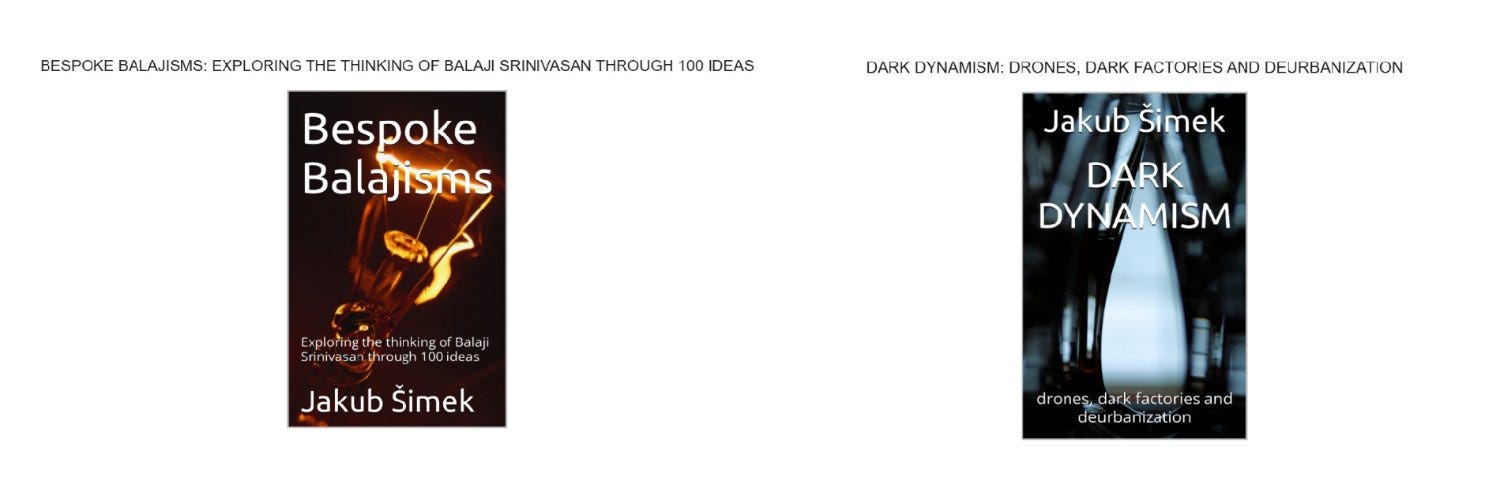
Last year I published my second book on Kindle, titled Dark Dynamism – On drones, dark factories and deurbanization. A year later the book is mostly useful as a collection of frameworks that might help with bootstrapping network states from startup villages – using tech to shrink sad blue cities into happy red/grey villages.
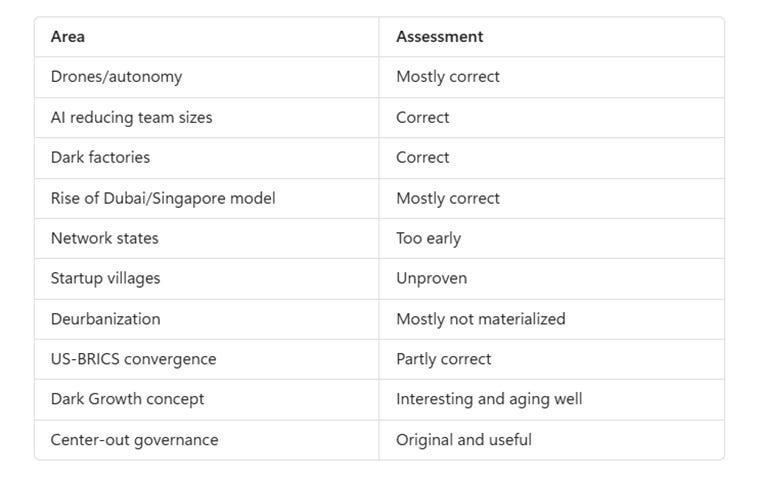
Some predictions have panned out. Drones and AI have become increasingly prominent, and dark factories are entering mainstream discourse. Deurbanization and a related reversal of demographic decline, however, remain largely speculative. What I call “Eurodecentrism” is happening slowly, but the US and BRICS convergence isn’t as pronounced.
I recently asked an AI copilot to evaluate which predictions aged well and which have yet to materialize:
My first book, Bespoke Balajisms was about 90 ideas of Balaji Srinivasan and 10 of my own takes. In the second book I tried to combine Balaji’s and Alexander Bard’s concepts with my own ideas relevant for builders of startups and startup societies.
Balaji sees startup societies as a natural progression from startups. Successful tech founders will go on creating successful communities built around certain moral innovations. His idea of techno-democracy is relevant both for local good governance and also for empowering a new era of civil society, or better yet - civil societies.
After writing the Network State, Balaji went on to create various pilots that could bring his vision closer to reality. With my Slovak and Kenyan friends, we took part in some of the early experiments (e.g. a crypto check-in and meetup app, a franchise of clubs like Soho, a crypto tasking platform, a meta-political party and a place where you can find your future spouse). Balaji ultimately settled on the Network School as the next practical step and built a real-world prototype.
I went to the first Network State Conference in Amsterdam, but I didn’t manage to visit Singapore or NS in Johor, Malaysia. In July this year, NS got into trouble by accident, due to local Malaysian politics and false online criticism, without breaking a law. Subsequently, Balaji requested an MoU from the government to prevent future harassment from local authorities, but the situation escalated and he managed to secure an MoU from Kazakhstan and relocate NS there within about a week.
I see Balaji’s current effort as creating a portable Silicon Valley for techno-optimists, amid an increasing hostility towards tech in the US and a secular US decline from its hyperpower era in the 1990s at the “end of history”.
My own view is that a more convincing “end of history” moment occurred in the 1960s, when Lee Kuan Yew transformed Singapore and created a template later adapted by Deng Xiaoping in China. I see current Balaji’s effort as creating also something like a “startup Singapore” a new attempt at a replicable blueprint for transforming countries towards prosperity and even starting new ones, in a bottom-up way from internet-first startup communities.
In my book Dark Dynamism, I tried to add a vertical dimension to this vision, by focusing on drones, dark factories and deurbanization. A year later I would expand and summarize this vision as:
Drones, dark factories and deurbanization can create abundant, family-friendly startup communities that gradually evolve into new forms of governance through experimentation and technological progress.
If I were Balaji, I would do parallel experiments to test opposite hypotheses - by having a NS in/near Singapore and in the US. As well as in some places like Kenya, Rwanda or El Salvador. Because the domain is complex and the practice is emerging (see Cynefin Framework).
The success metric for startup societies should not only be founder density, but also affordability. NS is currently priced around $1,500 per month per person. Imagine 10x that.
I would also do a bottom-up, top-down and center-out strategies at the same time. Seeing him pivoting from Malaysia to Kazakhstan in record time and signing an MoU with officials there is remarkable. A center-out strategy would be working with institutions like UNDP and their innovation team to advance network state-adjacent ideas and technologies.
A top-down strategy would involve partnering with India, US and China to build special innovation zones in places like Africa, creating synergies and combining comparative advantages. The US would contribute with startup culture, financing and research expertise, China with infrastructure and affordable technologies and India with tech talent and software.
Africa leapfrogged the West in mobile banking (M-Pesa in Kenya since 2007) and in drone delivery (Zipline in Rwanda since 2019). I think Africa can leapfrog the West also in AI adoption.
Following the fractal localism idea of Nassim Taleb, the China (startup) town, US (startup) town and India (startup) town could have their unique flavor and they can share common spaces.
I start my book Dark Dynamism with the essay on Eurodecentrism, my term that is the opposite to Eurocentrism. The colonial past connects the US to India, China and Africa. I illustrate Eurodecentrism by Volvo, that still has the luxury image but is owned by Geely and produces its cars also in the US.
After publishing my book last year, I had the opportunity to work on projects related to EU’s Global Gateway. In my follow up writing that might become Dark Dynamism 2.0, or something like Pragmatic Plugin, I want to explore the network state-adjacent ideas further. Positioning a global harmonization effort, such as EU’s Global Gateway on one end of the spectrum and something like a “local lock-in” (e.g. a US military base) on the other spectrum.
A Pragmatic Plugin would sit between global harmonization and local lock-in. It would work with local communities, respecting their values and lifestyles, while introducing technologies, institutions and governance experiments that increase prosperity, affordability and agency.
If AI democratizes intelligence and robotics democratizes production, then demography and human agency become new bottlenecks. Communities that cannot replace themselves eventually disappear, regardless of their technological sophistication.
In the AI era, intelligence becomes more abundant. What remains scarce is wisdom, which can only be acquired through action, experimentation and interaction with reality.
From a will to power in the industrial era, and a will to intelligence in the Internet era, we are moving towards a will-to-wisdom era.